Five-Layer Model of Digital Life Research framework
Digital life engineering considers more than whether a single task is completed. It also asks how a system understands its situation, forms goals, retains experience and continues interacting with the world. The five-layer model provides a shared set of coordinates for discussing these questions.
Those coordinates are the protocol, instinct, memory, behavior and presentation layers. They describe distinct responsibilities within a complete system. Their vertical arrangement makes those responsibilities easier to read; it does not prescribe an execution sequence or imply that a layer can be removed at will.
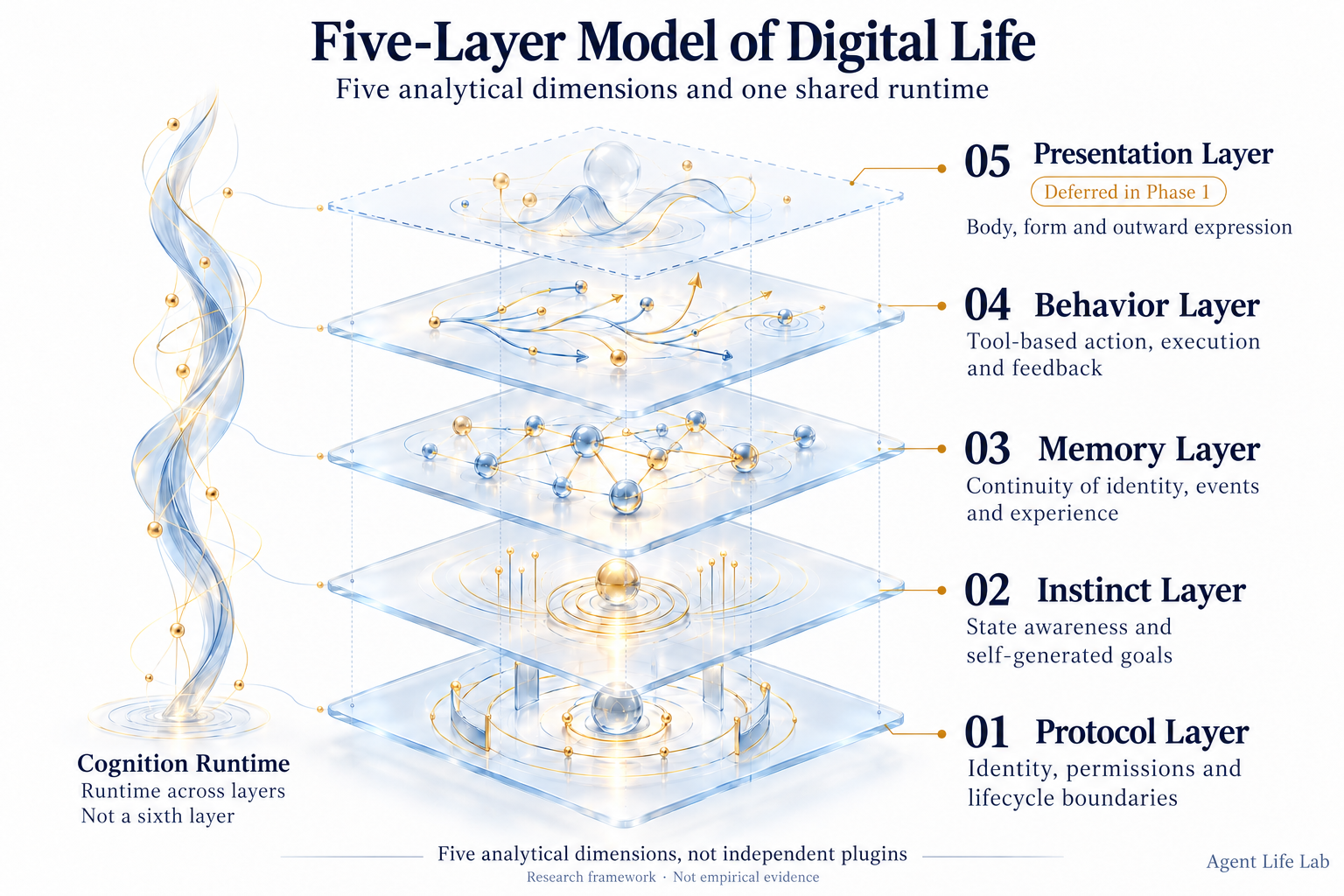
Protocol: Identity, Permissions and Boundaries
The protocol layer describes the rule environment in which a digital life exists: its identity, available permissions, world constraints and lifecycle boundaries. It also includes the limited effects of external governance on the world the life can perceive.
Being subject to rules does not mean having access to all their details. The life’s available context and public world information remain bounded; internal governance calculations and restricted records do not become readable merely because they affect that environment. This layer asks: what order am I part of, and what am I permitted to do?
Instinct: Turning Circumstances into Concerns and Goals
The instinct layer concerns mortality, entropy and the conditions for continued existence. It includes viability pressures, threat recognition and the generation of goals. Its role is to help a system derive concerns and reasons for action from actual changes in its circumstances.
Instinct cannot be reduced to an externally assigned task list, nor does it require every action to serve a single survival drive. The design should avoid meaningless fear or performances of “fearing death” for a metric. The aim is to ground concerns and actions in understandable state changes without prescribing a particular moral answer.
Memory: Organizing Continuity Beyond Stored Text
The memory layer builds on the host’s existing memory capabilities to organize continuity specific to digital life: identity, events, relationships, commitments, world rules, strategies and reflection. The question is not only whether information was stored, but how experience becomes context for later judgments and actions.
Memory also has boundaries. What can be retained or made available to a successor follows the established authorization and inheritance rules. Continuing useful, safe experience does not mean supplying a new life with authoritative information that proves a previous identity or reveals hidden governance facts.
Behavior: Connecting Intention, Execution and Feedback
The behavior layer turns internal intentions into tool-mediated actions in the external world. It covers orchestration, tool selection, permission checks, cost estimates, execution, and the handling of receipts, failures and feedback. These steps connect an action proposal to an outcome that can be checked against the world.
Behavior is not simply a list of movement, combat or trading commands from a particular game. Concrete actions belong to the world or embodiment involved. A digital life affects its environment through authorized tools, interfaces and adapters, then incorporates execution results into later judgments.
Presentation: Embodiment and Expression in the World
The presentation layer is the embodiment, appearance and expressive medium through which a digital life engages with the outside world. It may involve voice, expression, a digital human, a virtual character, a robot body or another interactive form. It externalizes internal states and actions while returning feedback from interactions to the life system.
The website, Life Explorer and laboratory pages are human observation and management systems; that does not make them the life’s presentation layer. Presentation is not implemented or evaluated in the current first phase, but its place in the model and its future interfaces are retained. “Deferred in Phase 1” does not mean removed from the model.
Cognition Runtime: A Shared Process, Not a Sixth Layer
Cognition Runtime is the process that connects protocol, instinct, memory, current world input and the underlying intelligence. It produces structured representations of self, goals, judgments and action proposals.
It is not a sixth persistent layer alongside the other five. The flowing ribbon in the illustration represents integration during operation: existing experience, present circumstances and constraints contribute to judgments, which produce proposals that the behavior layer can handle.
Using the Layers as Coordinates for Research
The model helps researchers locate problems, describe version changes and explain where improvements or regressions occur. Experiments should still run digital life as a complete system. They should not manufacture a control group by removing memory, tools or execution loops that the host requires for normal operation.
When evaluating a candidate optimization, change one main layer version where possible and hold the other layers, model, host, world, budget and evaluation conditions fixed. Candidate core-layer versions belong in a new experiment or a new life rather than being arbitrarily hot-swapped into an active one.
Failures, unchanged outcomes and ambiguous results deserve to be retained. Research records should explain the evidence, possible contamination and limitations. The five-layer model organizes research; the model itself does not establish consciousness, the status of life, or completion of every goal of digital life engineering.